Babashka 1.13.220 gets FFI
Today babashka 1.13.220 is released, with a new babashka.ffi namespace for calling C libraries directly from Babashka scripts. The babashka.ffi library is also available as a standalone library for JVM Clojure, so you can use it in your Clojure projects as well. Note that the API is still experimental, although no changes are currently planned. It just needs more exposure and your feedback :). Here's a small demo.
Calling C
This example loads libz from your system and requests the version.
(require '[babashka.ffi :as ffi :refer [defcfn]])

(def zlib (ffi/load-system-library "z"))
(def zlib-version (ffi/cfn zlib "zlibVersion" [] :string))

(zlib-version)
;;=> "1.3.1"
This example loads an OS-specific library for doing math:
(ffi/load-library
 {:mac "libm.dylib"
  :linux "libm.so.6"
  :windows "ucrtbase.dll"})

(defcfn cos "cos" [:double] :double)
(defcfn pow "pow" [:double :double] :double)

(cos 0.0)      ;;=> 1.0
(pow 2.0 10.0) ;;=> 1024.0
To get a feeling for how to use it in larger, non-trivial projects, read the library guide. Some of the API decisions like defcfn are clearly inspired by coffi, so I want to thank Joshua Suskalo for leading the way with his excellent library. But babashka.ffi is not simply a copy of coffi. It does a few things differently. You can provide an explicit library (or a function or delay that resolves to one) to defcfn for example. Also it has a place concept (inspired by Specter's paths) that efficiently lets you read from and write to structs and unions. Like coffi, babashka.ffi builds on java.lang.foreign and makes you manage memory explicitly through arenas. One benefit of this is that you'll get exceptions rather than segfaults that tear down your REPL and you can use with-open to release allocated memory.
Install
To use babashka.ffi and libraries that build on it, you have to use a dynamically linked version of babashka. On Mac and Windows this was always the default. On Linux, the static binary was preferred historically since it did not depend on your system's libc and zlib. In this release we flip this default to a mostly-static binary: all the shared C libraries that babashka needs are statically linked, and glibc is the only dynamically linked part. The aarch64 binary, although it carries -static in its name, was already built this way. Babashka on Linux is built in a container that pins the glibc version to the lowest one possible so it should work on all mainstream LTS versions of Linux today. If you still prefer the fully static binary, you can use the install script with the --static flag. If you use a package manager or a GitHub Action to install babashka, it may not yet be up to date with this new policy. If that is the case, feel free to open an issue at the babashka GitHub repo and I'll reach out to get this fixed. Meanwhile you can install babashka using the installer script on GitHub to a temporary directory to get a second installation of babashka with FFI enabled:
$ curl -sLO https://raw.githubusercontent.com/babashka/babashka/master/install
$ bash install --dir /tmp/bb-test
$ /tmp/bb-test/bb -e "(require '[babashka.ffi :as ffi]) (ffi/load-system-library \"z\")"
The installer script probes your system for the supported glibc version and falls back to the fully static version when necessary.
Demos
To validate the design of babashka.ffi, I built a few shiny demos:
- pacman.clj: pac-man with the classic ghost personalities (requires raylib)
- doom.clj: a raycaster with textures and sprites (requires raylib)
- helitorus.clj: a helix around a torus (requires raylib)
- gtk4.clj: a native GTK 4 window rendering from an atom
- portaudio.clj: an arpeggio through a realtime audio callback
- python.clj: embedded CPython calling back into Clojure
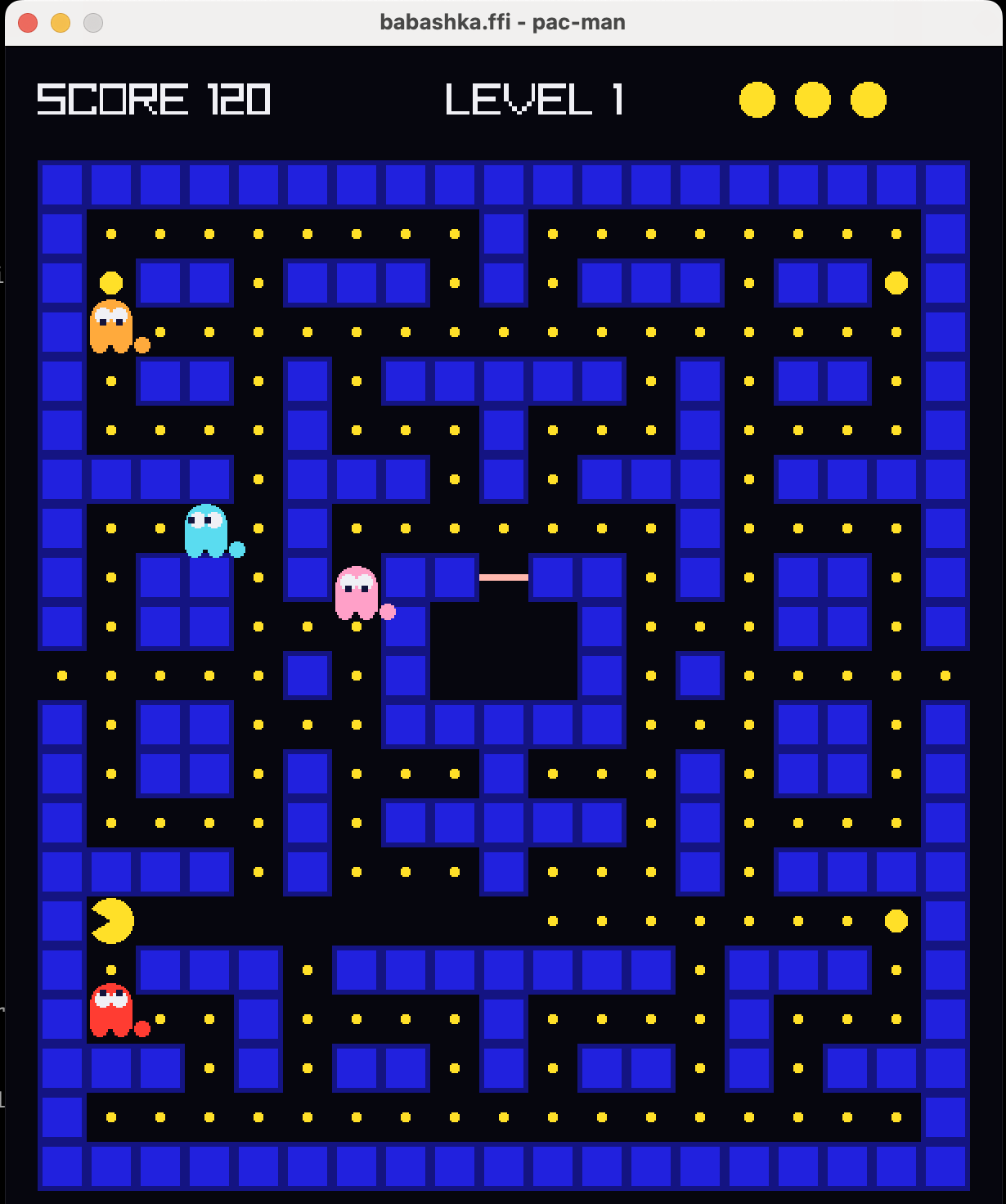
A one-liner to try these demos:
$ bb -e '(load-string (slurp "https://raw.githubusercontent.com/babashka/ffi/main/examples/pacman.clj"))'
FFI-based libraries
To validate the design of babashka.ffi even more, a couple of new libraries were born. These libraries mostly resemble existing pods but now use FFI to fulfill similar use cases.
One cool thing you could not do with a pod before is defining a Clojure function in SQLite:
(require '[babashka.sqlite :as sq])

(sq/with-conn [db nil]
  (sq/create-function! db "initials"
    (fn [s] (apply str (map first (clojure.string/split s #" ")))))
  (sq/query db ["select initials(?) i" "gerald jay sussman"]))
;;=> [{:i "gjs"}]
Tasks: :exec-fn composition
This release also has some really nice task improvements: :exec-fn tasks now compose through :depends. A task can depend on another CLI task, and the dependency's options parse, coerce and show up in --help and shell completion:
{:tasks
 {compile {:exec-fn build/compile-sources
           :cli {:spec {:release {:coerce :boolean}}}}
  jar     {:depends [compile]
           :exec-fn build/jar}}}
$ bb jar --help
...
Inherited options:
  --release
Also you can now directly provide :exec-args on a task:
{:tasks
 {deploy {:exec-fn deploy/run
          :exec-args {:env "staging"}}}}
A :cmd tree can now be provided through a var, whose namespace is loaded on demand:
{:tasks
 {cli {:cmd my.project.cli/commands}}}
AI disclosure
While developing FFI and while validating the design through examples and writing libraries, I have made use of LLM assistance.
Wrapping up
Hope you'll like these new features!
The full changelog can be found here.
Published: 2026-08-31