Babashka 1.12.215: Revenge of the TUIs
Babashka is a fast-starting native Clojure scripting runtime. It uses SCI to interpret Clojure and compiles to a native binary via GraalVM, giving you Clojure's power with near-instant startup. It's commonly used for shell scripting, build tooling, and small CLI applications. If you don't yet have bb installed, you can with brew:
brew install borkdude/brew/babashka
or bash:
bash <(curl -s https://raw.githubusercontent.com/babashka/babashka/master/install)
This release is, in my opinion, a game changer. With JLine3 bundled, you can now build full terminal user interfaces in babashka. The bb repl has been completely overhauled with multi-line editing, completions, and eldoc. deftype now supports map interfaces, making bb more compatible with existing libraries like core.cache. SCI has had many small improvements, making riddley compatible too. Riddley is used in Cloverage, a code coverage library for Clojure, which now also works with babashka (Cloverage PR pending).
Babashka conf 2026
But first, let me mention an exciting upcoming event! Babashka conf is happening again for the second time! The first time was 2023 in Berlin. This time it's in Amsterdam. The Call for Proposals is open until the end of February, so there is still time to submit your talk or workshop. We are also looking for one last gold sponsor (500 euros) to cover all costs.
Highlights
JLine3 and TUI support
Babashka now bundles JLine3, a Java library for building interactive terminal applications. You get terminals, line readers with history and tab completion, styled output, keyboard bindings, and the ability to reify custom completers, parsers, and widgets — all from bb scripts.
JLine3 works on all platforms, including Windows PowerShell and cmd.exe.
Here's a simple interactive prompt that reads lines from the user until EOF (Ctrl+D):
(import '[org.jline.terminal TerminalBuilder]
        '[org.jline.reader LineReaderBuilder])

(let [terminal (-> (TerminalBuilder/builder) (.build))
      reader   (-> (LineReaderBuilder/builder)
                   (.terminal terminal)
                   (.build))]
  (try
    (loop []
      (when-let [line (.readLine reader "prompt> ")]
        (println "You typed:" line)
        (recur)))
    (catch org.jline.reader.EndOfFileException _
      (println "Goodbye!"))
    (finally
      (.close terminal))))
babashka.terminal namespace
A new babashka.terminal namespace exposes a tty? function to detect whether stdin, stdout, or stderr is connected to a terminal:
(require '[babashka.terminal :refer [tty?]])

(when (tty? :stdout)
  (println "Interactive terminal detected, enabling colors"))
This accepts :stdin, :stdout, or :stderr as argument. It uses JLine3's terminal provider under the hood.
This is useful for scripts that want to behave differently when piped vs. run interactively, for example enabling colored output or progress bars only in a terminal.
charm.clj compatibility
charm.clj is a new Clojure library for building terminal user interfaces using the Elm architecture (Model-Update-View). It provides components like spinners, text inputs, lists, paginators, and progress bars, with support for ANSI/256/true color styling and keyboard/mouse input handling.
charm.clj is now compatible with babashka (or rather, babashka is now compatible with charm.clj), enabled by the combination of JLine3 support and other interpreter improvements in this release. This means you can build rich TUI applications that start instantly as native binaries.
Here's a complete counter example you can save as a single file and run with bb:
#!/usr/bin/env bb

(babashka.deps/add-deps
 '{:deps {io.github.TimoKramer/charm.clj {:git/sha "cf7a6c2fcfcccc44fcf04996e264183aa49a70d6"}}})

(require '[charm.core :as charm])

(def title-style
  (charm/style :fg charm/magenta :bold true))

(def count-style
  (charm/style :fg charm/cyan
               :padding [0 1]
               :border charm/rounded-border))

(defn update-fn [state msg]
  (cond
    (or (charm/key-match? msg "q")
        (charm/key-match? msg "ctrl+c"))
    [state charm/quit-cmd]

    (or (charm/key-match? msg "k")
        (charm/key-match? msg :up))
    [(update state :count inc) nil]

    (or (charm/key-match? msg "j")
        (charm/key-match? msg :down))
    [(update state :count dec) nil]

    :else
    [state nil]))

(defn view [state]
  (str (charm/render title-style "Counter App") "\n\n"
       (charm/render count-style (str (:count state))) "\n\n"
       "j/k or arrows to change\n"
       "q to quit"))

(charm/run {:init {:count 0}
            :update update-fn
            :view view
            :alt-screen true})
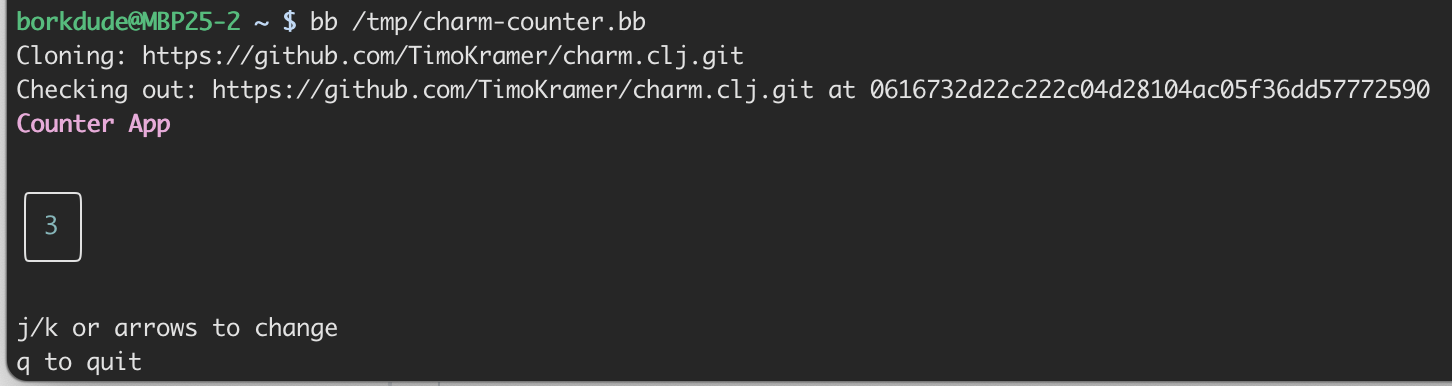
More examples can be found here.
Deftype with map interfaces
Until now, deftype in babashka couldn't implement JVM interfaces like IPersistentMap, ILookup, or Associative. This meant libraries that define custom map-like types, a very common Clojure pattern, couldn't work in babashka.
Starting with this release, deftype supports map interfaces. Your deftype must declare IPersistentMap to signal that you want a full map type. Other map-related interfaces like ILookup, Associative, Counted, Seqable, and Iterable are accepted freely since the underlying class already implements them.
This unlocks several libraries that were previously incompatible:
- core.cache: all cache types (BasicCache, FIFOCache, LRUCache, TTLCache, LUCache) work unmodified
- linked: insertion-ordered maps and sets
Riddley and Cloverage compatibility
Riddley is a Clojure library for code walking that many other libraries depend on. Previously, SCI's deftype and case did not macroexpand to the same special forms as JVM Clojure, which broke riddley's walker. Several changes now align SCI's behavior with Clojure: deftype macroexpands to deftype*, case to case*, and macroexpand-1 now accepts an optional env map as second argument (inspired by how the CLJS analyzer API works). Together these changes enable riddley and tools built on it, like cloverage and Specter, to work with bb.
Riddley has moved to clj-commons, thanks to Zach Tellman for transferring it. I'd like to thank Zach for all his contributions to the Clojure community over the years. Version 0.2.2 includes bb compatibility, which was one of the first PRs merged after the transfer. Cloverage compatibility has been submitted upstream, all 75 cloverage tests pass on both JVM and babashka.
Console REPL improvements
The bb repl experience has been significantly improved with JLine3 integration. You no longer need rlwrap to get a comfortable console REPL:
- Multi-line editing: the REPL detects incomplete forms and continues reading on the next line with a
#_=>continuation prompt - Tab completion: Clojure-aware completions powered by SCI, including keywords (
:foo,::foo,::alias/foo)
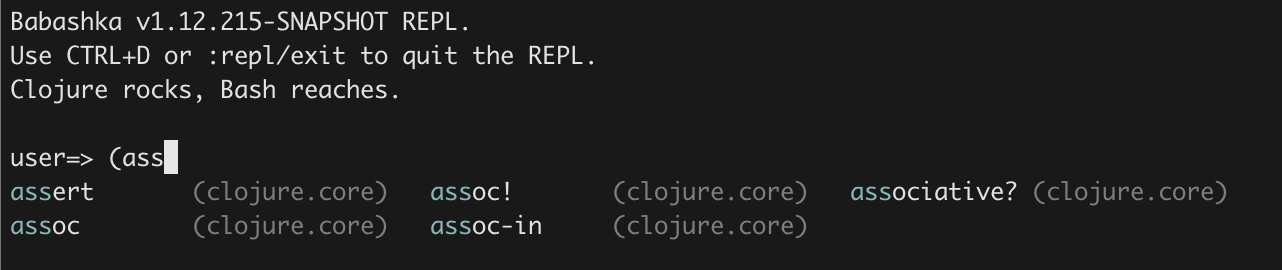
- Ghost text: as you type, the common completion prefix appears as faint inline text after the cursor. Press TAB to accept.

- Eldoc: automatic argument help — when your cursor is inside a function call like
(map |), the arglists are displayed below the prompt - Doc-at-point: press Ctrl+X Ctrl+D to show full documentation for the symbol at the cursor
- Persistent history: command history saved across sessions in
~/.bb_repl_history - Ctrl+C handling: first press on an empty prompt warns, second press exits
Many of these features were inspired by rebel-readline, Leiningen's REPL, and Node.js's REPL.
SCI improvements
Under the hood, SCI (the interpreter powering babashka) received many improvements in this cycle:
- Functional interface adaptation for instance targets: you can now write
(let [^Predicate p even?] (.test p 42))and SCI will adapt the Clojure function to the functional interface automatically. - Type tag inference: SCI now infers type tags from
letbinding values to binding names, reducing the need for explicit type hints in interop-heavy code. - Several bug fixes:
readwithnil/falseas eof-value,letfnwith duplicate function names,ns-mapnot reflecting shadowed vars, NPE inresolve, and.methodon class objects routing incorrectly.
Other improvements
- Support multiple
catchclauses in combination with^:sci/error - Fix
satisfies?on protocols withproxy - Support
reifywithjava.time.temporal.TemporalQuery - Fix
reifywith methods returningint/short/byte/floatprimitives - nREPL server now uses non-daemon threads so the process stays alive without
@(promise) - Add
clojure.test.junitas built-in source namespace - Add cp437 (IBM437) charset support in native binary via selective GraalVM charset Feature, avoiding the ~5MB binary size increase from
AddAllCharsets. More charsets can be added on request.
For the full list of changes including new Java classes and library bumps, see the changelog.
Thanks
Thank you to all the contributors who helped make this release possible. Special thanks to everyone who reported issues, tested pre-release builds from babashka-dev-builds, and provided feedback.
Thanks to Clojurists Together and all babashka sponsors and contributors for their ongoing support. Your sponsorship makes it possible to keep developing babashka.
And thanks to all babashka users: you make this project what it is. Happy scripting!
Published: 2026-02-17